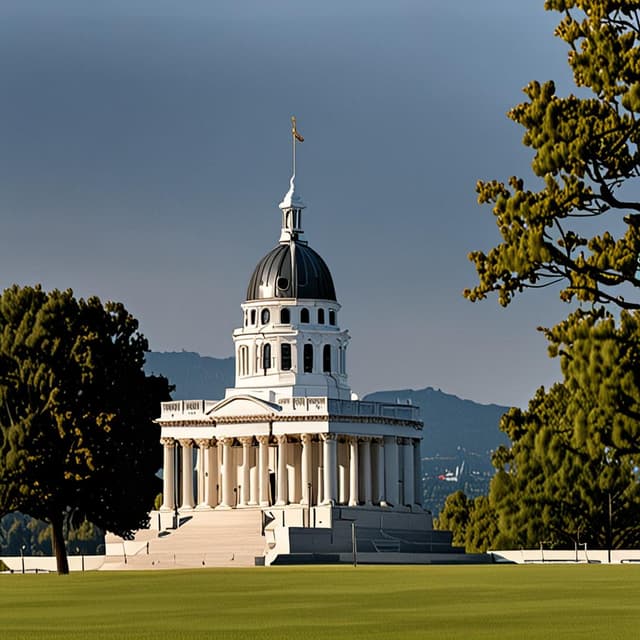
| Name | New Jerusalem |
| Type | State |
| Region | Northeastern United States |
| Founding | Puritan Christian settlers |
| Government | Fundamentalist Christian theocracy |
| Population | Over 3 million |
| Established | Late 18th century |
| Key Characteristics | Strict enforcement of biblical law • Frequent conflicts with federal government • Reliable voting bloc for religious right |
New Jerusalem is a state in the northeastern United States with a population of just over 3 million people. Established in the late 18th century by Puritan Christian settlers, New Jerusalem has a long history of theocratic governance and conservative social values that set it apart from the rest of the country.
In the 1780s, a group of Puritan families from Massachusetts and Connecticut migrated west in search of land to establish a new "New Jerusalem" - a utopian Christian society free from the corrupting influences of the outside world. After receiving a land grant from the U.S. government, they settled in a remote, mountainous region and founded the town of New Canaan, which would eventually become the state capital.
The settlers were highly educated and deeply religious, seeking to build a society strictly governed by biblical law. They established a series of small farming communities bound by a shared Calvinist theology and a commitment to moral purity. Over several generations, these towns coalesced into the state of New Jerusalem.
From its inception, New Jerusalem has been ruled by a theocratic government dominated by various fundamentalist Christian sects. The state constitution enshrines Christianity as the official state religion, and gives broad powers to a council of religious elders to dictate legislation, law enforcement, and social policies.
All levels of government, from the statehouse to local town councils, are elected on the basis of strict adherence to conservative Christian doctrine. Public schools and other institutions are mandated to provide extensive religious instruction, with subjects like creationism and biblical law taking priority over secular topics. Dissent from the official state religion is harshly punished.
New Jerusalem has a population that is overwhelmingly white, Protestant, and socially conservative. Over 90% of residents identify as some form of evangelical or fundamentalist Christian, with Calvinists, Puritans, and Pentecostals being the largest denominations. Racial and religious minorities face significant discrimination and barriers to full participation in society.
The state's culture is centered around strict observance of traditional gender roles, large families, and absolute obedience to religious authority. Recreation, media, and the arts are all strictly controlled to adhere to "godly" values. Homosexuality, premarital sex, and other "sins" are criminalized, with violators facing harsh penalties.
New Jerusalem's theocratic governance and hardline social policies have put it in frequent conflict with the federal government and the broader American values of individual rights and separation of church and state. The state has resisted federal civil rights legislation, environmental regulations, and other policies perceived as contrary to biblical law.
Standoffs over issues like abortion access, LGBTQ+ rights, and compulsory religious education have led to protracted legal battles and occasional threats of secession. New Jerusalem's insular, fundamentalist culture has also raised national security concerns, with the state being a recruiting ground for extremist Christian militias.
Despite these ongoing tensions, New Jerusalem remains a fixture in American politics, wielding outsized influence through its reliable voting bloc in national elections. Its unwavering adherence to traditional Christian values has made it a touchstone for the religious right across the country.
